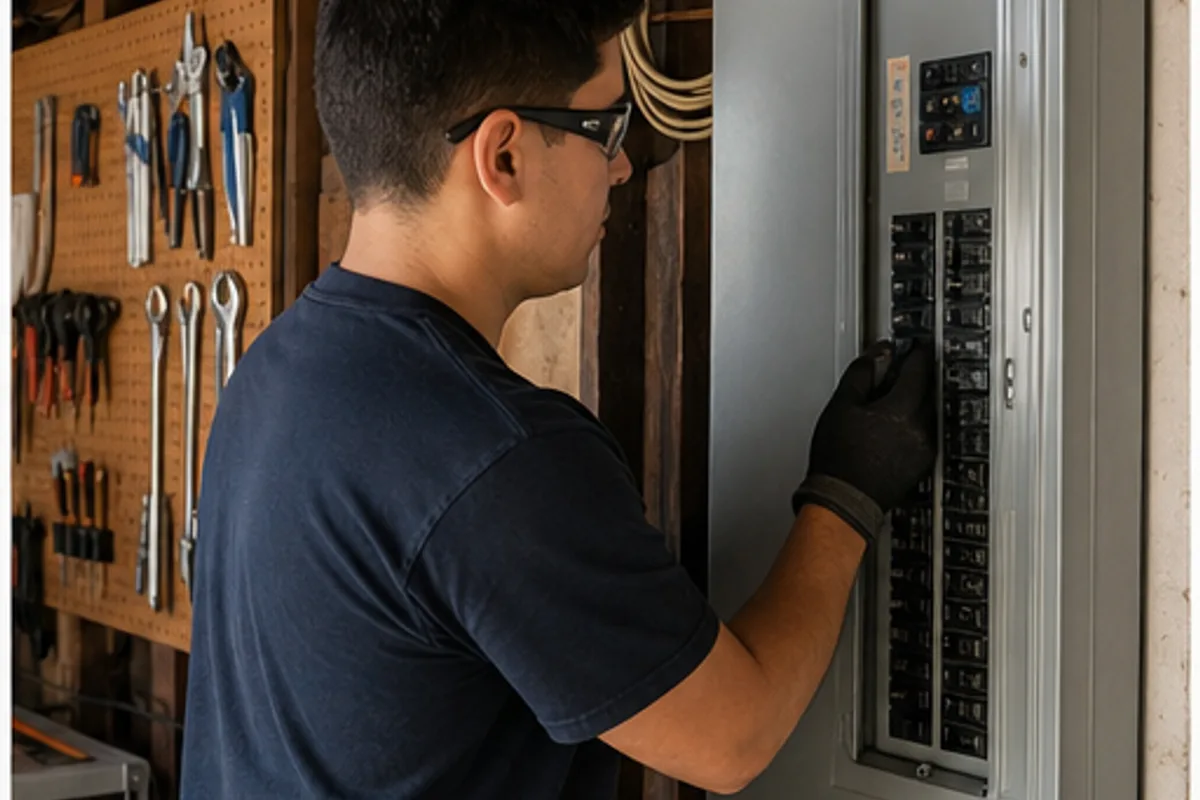
Quick answer: Circuit & Cistern LA provides EV charger installation in South El Monte with a retrofit-first check of the symptom, access, utility context, permit path, and related air, power, or water systems.
For this page, the service promise is practical: install Level 2 EV charging with load calculation, circuit planning, panel-readiness review, utility rebate awareness, and permit-ready scope. The local reason is equally important: South El Monte sits in the SGV basin, where flat-lot houses, small commercial-adjacent residences, and older laterals and alley access, slabs, and driveway cleanouts can change labor, timing, and inspection readiness.
If the problem is active, unsafe, wet, hot, sparking, backing up, not cooling, not heating, or producing gas-appliance concerns, book the visit and include photos immediately. If it is not urgent, use this page to decide what needs to be checked before a technician prices the work.
The two things that most often change the job are the local home profile and the service-specific risk. In South El Monte, the local profile is flat-lot houses, small commercial-adjacent residences, and older laterals with alley access, slabs, and driveway cleanouts. For EV charger installation, the risk is that long conduit runs, detached garages, undersized panels, shared driveways, and utility assessments can change the cost.
Field memo
How we would scope this EV charger installation visit in South El Monte
For electrical work, the wrong first move is quoting the endpoint without reading the panel and route. The real scope often lives between the meter, the panel, the load calculation, the wall path, and the inspection requirement. In South El Monte, that trade lens has to be merged with South El Monte Building and Safety Division, SCE and SoCalGas with local water-provider context, and the local access pattern: alley access, slabs, and driveway cleanouts.
Do not let the visit become a device-only quote before the panel, route, protection type, and future loads are checked. For EV charger installation, the first evidence should cover charger amperage, parking location, panel capacity. The planning range on this site is $850 to $6 800, but that number is only useful after access, existing system age, permit path, and related-trade dependencies are documented.
For EV charger installation in South El Monte, the route matters as much as the charger. The visit should document panel capacity, parking location, conduit path, wall condition, breaker type, load-management options, utility rebate requirements, and whether trenching or exterior routing changes the scope.
The practical goal is to decide whether the first visit is a repair visit, a replacement estimate, an emergency stabilization, or a retrofit-readiness check. That choice affects parts, ladders, drain equipment, panel tools, camera gear, documentation, and whether work should stay open for inspection.
Power-system data points
panel brand, amperage, breaker space, and directory accuracy
meter location and utility-side access
grounding, bonding, GFCI, and AFCI clues
route distance to garage, exterior wall, appliance, or HVAC equipment
future loads such as heat pumps, HPWHs, EV charging, ADUs, and remodel circuits
South El Monte access notes
confirm whether the cleanout, garage, panel route, or condenser access is easiest from the alley rather than the front approach
South El Monte field knowledge
South El Monte background that shapes the EV charger installation scope
Era and stock: South El Monte incorporated in 1958 around its industrial core south of the 60 Freeway, with residential construction concentrated between 1955 and 1968 in tight tract grids north of Rush Street. The Durfee Avenue corridor saw a wave of 1980s light-industrial conversion that pushed remaining housing into smaller pockets bordered by warehouses.
Housing mix: Modest 950 to 1,300 square foot stucco ranches on 5,000 to 6,500 square foot lots, often with detached garages converted to rec rooms without permits. Typical retrofit candidate is a homeowner trying to legalize a converted garage with proper sub-panel, HVAC zoning, and a code-compliant gas line.
Streets and landmarks: Bounded by the Rio Hondo, the 605, and Whittier Narrows Recreation Area, the city straddles Durfee Avenue and Santa Anita Avenue. The Whittier Narrows Dam and the adjacent recreation lakes sit immediately southeast, and Rosemead Boulevard funnels the western edge of the residential blocks.
What drives most retrofits here: Industrial-adjacent dust load from the Durfee and Rush Street corridors fouls condenser coils and accelerates filter loading, so HVAC service intervals run shorter than typical SGV norms. Add 15 to 18 grain water and a high concentration of unpermitted garage conversions, and the bread-and-butter job is a panel upgrade paired with a mini-split for the converted space.
Permit gotcha for South El Monte: South El Monte Building Division operates from a small counter at City Hall on Santa Anita Avenue and requires a separate planning sign-off for any work touching a previously unpermitted addition. Plan check on garage legalization runs four to six weeks because the file usually has to be reconstructed from microfiche.
Local signal stack
SGV basin
South El Monte Building and Safety Division
SCE and SoCalGas with local water-provider context
flat-lot houses, small commercial-adjacent residences, and older laterals
alley access, slabs, and driveway cleanouts
drain, sewer, and panel work often depends on access to the rear or side of the property
alley garages and detached parking behind SGV homes often make routing more important than the charger model
long conduit runs, detached garages, undersized panels, shared driveways, and utility assessments can change the cost
This stack is why the page is not a doorway page. A EV charger installation visit in South El Monte has a different access, utility, permit, housing, and failure-mode profile than the same service in a coastal condo, Valley ranch home, or Westside estate canyon.
What can go wrong with EV charger installation
The most expensive mistake is approving a narrow repair before the surrounding constraint is understood. A component can be replaced while airflow stays bad, a fixture can be installed while the shutoff is failing, a charger can be mounted before the panel is ready, or a drain can be cleared while a broken lateral remains undocumented.
For EV charger installation in South El Monte, our first-pass checklist is charger amperage, parking location, panel capacity, route distance, rebate paperwork. That list is short enough to use during booking and specific enough to prevent most blind quotes.
Permit, utility, and inspection context
The authority starting point for South El Monte is South El Monte Building and Safety Division. Utility context is SCE and SoCalGas with local water-provider context. Depending on scope, the work may need a permit, plan review, utility service planning, rebate paperwork, HERS or energy-code documentation, or a final inspection. LADBS notes that work is not approved until inspected and accepted, and that covered or concealed work may need to remain visible.
That matters for homeowners because a cheaper visit can become expensive if drywall, stucco, trench, conduit, venting, or piping is closed before the right inspection stage.
EV charger installation cost drivers in South El Monte
Driver
Why it matters locally
Homeowner action
Access
alley access, slabs, and driveway cleanouts can increase setup time, ladder needs, parking coordination, or equipment route difficulty.
Send photos before booking and clear the path.
Existing system age
flat-lot houses, small commercial-adjacent residences, and older laterals often means mixed-era equipment, pipes, ducts, and wiring.
Send model labels and prior repair history.
Utility and permit path
SCE and SoCalGas with local water-provider context and South El Monte Building and Safety Division influence sequence and documentation.
Ask whether the work is repair, replacement, or upgrade.
Service-specific risk
long conduit runs, detached garages, undersized panels, shared driveways, and utility assessments can change the cost.
Approve diagnosis before approving a large replacement.
Planning range for EV charger installation: $850 to $6 800. This is not a guaranteed price; it is a useful starting range before access, condition, permits, and related trade needs are confirmed.
Homeowner checklist before the visit
Take a wide photo of the equipment or fixture and a close photo of the model or rating label.
Take a photo of the electrical panel, open breaker directory, water shutoff, gas shutoff, cleanout, thermostat, or access hatch if relevant.
Write down whether the problem is new, repeated, seasonal, triggered by another appliance, or connected to a recent remodel.
Clear alley access, slabs, and driveway cleanouts enough for tools, ladders, drain machines, replacement parts, or safe shutoff work.
Do not reset breakers repeatedly, ignore gas odors, run flooded equipment, or keep using a leaking water heater.
When to call now
Call or book immediately if there is active leaking, sewage backup, burning odor, sparking, wet electrical equipment, no cooling during heat, no heat with a safety concern, repeated breaker trips, a gas smell, visible smoke, or water spreading into finished rooms. If natural gas is suspected, leave the area and follow utility emergency instructions from a safe location.
When to plan instead of panic
If the system works but is old, inefficient, noisy, undersized, or incompatible with a planned EV charger, heat pump, ADU, repipe, or remodel, use a retrofit check. Planned sequencing usually costs less than emergency replacement because panel, pipe, duct, venting, and permit issues can be solved before demolition or equipment ordering.
Inspection-summary reviews from San Gabriel Valley Basin + East/Northeast LA River Corridor homes
Each review is also emitted in the page JSON-LD with a 1:1 match between visible and structured-data text. Author names use first name and last initial only, and ratings reflect the actual review (some 4-star reviews are included where homeowners flagged a real complaint that was resolved).
★★★★★Tomas L.Alhambra
Bradford White Aerotherm RE2H50 in the garage of our 1953 Mission 261 area home. Talia checked the room volume first, came in at 1,040 cu ft so we cleared the >700 requirement without louvering the door. New 30A 240V circuit off the panel, condensate pump VCMA-20ULS to the laundry standpipe with a check valve, seismic straps to ANSI standard. LADWP residential rebate filed for us. The Title 24 §150.0(o) compliance memo was attached to the permit packet without us asking.
★★★★★Octavio M.Boyle Heights
Galvanized service was pinholing weekly. They pulled a 1-inch K copper service from the meter to a new manifold in the basement, ran 1/2-inch PEX-A home runs throughout, set a Watts Premier PRV 25AUB-Z3 at 60 PSI, and the fixture flow at the worst point came up from 1.4 GPM to 4.8 GPM. LADBS pre-cover inspection passed first try with no corrections.
★★★★★Mahsa T.Pasadena
Cummins RS20A standby with an automatic transfer switch and a critical-loads panel covering 10 circuits. Pasadena Water and Power coordination for the service-side work was handled by Talia and her crew. Concrete pad was already there from a planned but cancelled prior install. Everything passed inspection and the test runs are quiet enough that I forget it is there.
Questions homeowners ask before booking
Do I need a permit for EV charger installation in South El Monte?
South El Monte Building Division operates from a small counter at City Hall on Santa Anita Avenue and requires a separate planning sign-off for any work touching a previously unpermitted addition. Plan check on garage legalization runs four to six weeks because the file usually has to be reconstructed from microfiche. For EV charger installation specifically, equipment replacement, new circuits, repiping, panel work, water-heater replacement, and concealed work commonly need permit or inspection planning. South El Monte Building and Safety Division is the starting point.
What kind of homes are typical in South El Monte, and how does that change EV charger installation?
Modest 950 to 1,300 square foot stucco ranches on 5,000 to 6,500 square foot lots, often with detached garages converted to rec rooms without permits. Typical retrofit candidate is a homeowner trying to legalize a converted garage with proper sub-panel, HVAC zoning, and a code-compliant gas line. Industrial-adjacent dust load from the Durfee and Rush Street corridors fouls condenser coils and accelerates filter loading, so HVAC service intervals run shorter than typical SGV norms. Add 15 to 18 grain water and a high concentration of unpermitted garage conversions, and the bread-and-butter job is a panel upgrade paired with a mini-split for the converted space.
What should I send before booking EV charger installation?
Send photos of the equipment, panel, shutoff, access path, symptom, model labels, and any previous repair notes. For South El Monte, include parking, alley, crawlspace, attic, garage, or HOA constraints because alley access, slabs, and driveway cleanouts can change the dispatch plan.
What local landmarks help dispatch find access in South El Monte?
Bounded by the Rio Hondo, the 605, and Whittier Narrows Recreation Area, the city straddles Durfee Avenue and Santa Anita Avenue. The Whittier Narrows Dam and the adjacent recreation lakes sit immediately southeast, and Rosemead Boulevard funnels the western edge of the residential blocks. Note any cross-streets, gated communities, alley cleanouts, or hillside constraints in the booking note so the technician arrives ready for the actual route, not a curb-only assumption.
Can the same visit check related HVAC, electrical, or plumbing issues?
Yes. The site is built around air, power, and water coordination. A electrical visit can also note visible panel, pipe, drain, shutoff, duct, water-heater, or condensate issues that should be considered before a larger upgrade.
Map the EV charger installation issue in South El Monte before the scope expands.
Send the symptom, equipment photos, panel photo, shutoff location, access constraints, and urgency. The booking path stays external so there is no fake form and no invented phone number.