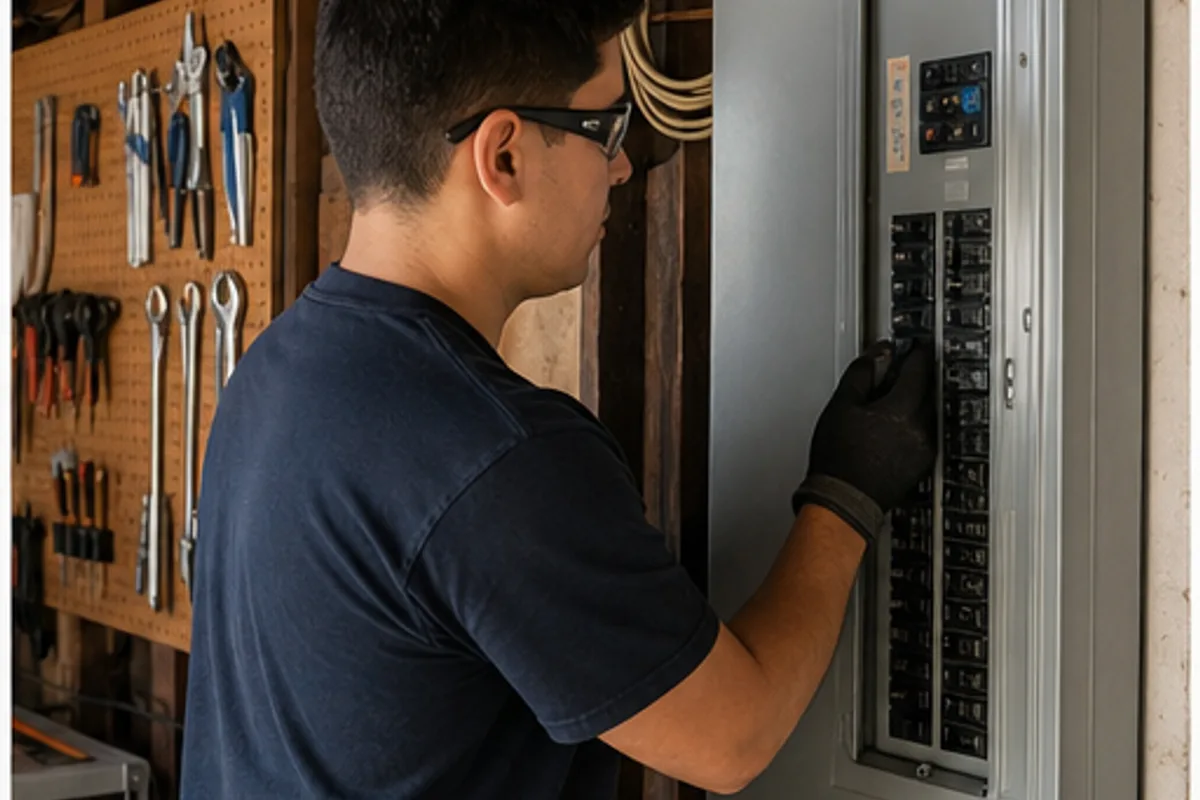
Short answer: Circuit & Cistern LA handles electrical panel upgrade by checking the symptom, the system around it, and the local constraints that can change the repair. For this service, that means we upgrade or replace unsafe, full, obsolete, or undersized panels for AC, heat pumps, EV chargers, HPWHs, ADUs, and remodel loads.
The key risk is simple: panel work can require utility coordination, meter location review, grounding updates, service clearance, and final inspection. That is why the page includes cost drivers, what can go wrong, permit context, utility overlap, homeowner prep, and local pages instead of only a generic "call now" pitch.
What we check before quoting electrical panel upgrade
LADWP, SCE, and Pasadena Water and Power neighborhoods need different service-planning steps. The visit starts with symptom photos, model labels, shutoff access, and the relevant route from the equipment to the panel, pipe, drain, duct, or exterior location.
existing amperage
breaker space
meter location
grounding and bonding
future loads
Cost range and drivers
Typical planning range: $2 800 to $12 500. The low side usually assumes clear access, existing infrastructure that can stay, and no major hidden defects. The high side usually involves replacement equipment, utility involvement, difficult routing, permit or inspection sequence, concealed damage, or multi-trade coordination.
Repair, replacement, or retrofit sequence
Path
When it fits
What can change the scope
Repair
The equipment or fixture is serviceable and the failure is isolated.
Old parts, unsafe wiring, bad shutoffs, inaccessible cleanouts, or failed venting.
Replacement
The system is at end of life, unsafe, inefficient, or no longer compatible with the home.
Permits, HERS, panel capacity, pipe material, duct sizing, condensate, or gas sizing.
Retrofit sequence
Several home systems should be staged so one upgrade does not block the next.
EV charger, heat pump, HPWH, ADU, remodel, repipe, or whole-home rewiring plans.
Three electrical panel upgrade misconceptions worth correcting
Misconception: Any 200A panel is interchangeable.
Reality: Square D QO 200A and Square D Homeline 200A both list at 200A but use different breaker families, different bus stab geometry, and different listed surge protectors. Eaton CH and Eaton BR have the same split. Mixing breaker brands inside a panel violates NEC 110.14 listing requirements unless the panel is specifically classified for cross-brand breakers; most are not.
Misconception: Panel upgrade is a one-day job with no SCE coordination.
Reality: A service-equipment swap requires SCE coordination for meter pull and reset, LADBS or Pasadena Permit Center electrical permit, and inspection before energization. Realistic timeline is 5 to 12 business days from permit to final, with one day of actual on-site work. Same-day energization without SCE is unauthorized backfeed.
Misconception: Grounding is just one rod at the panel.
Reality: NEC 250.50 and 250.53 require all available grounding electrodes bonded together: ufer (concrete-encased electrode), water service (within 5 feet of entry), and at least one supplemental rod if the resistance to ground is unverified. Older Linda Vista homes with a single 1959 ground rod do not meet current code; the upgrade includes electrode inventory.
What NOT to choose for electrical panel upgrade in older basin homes
Avoid the sub-panel-instead-of-service-upgrade pitch when the actual service drop is 100A with a 1958 cloth-insulated entrance cable. Adding a sub-panel does not relieve the bottleneck at the meter; it just extends it. Pull a load calc under NEC 220.83. If the calc lands above 80 amps, the conversation is service upgrade to 200A, not sub-panel addition.
Decline a panel install without integrated surge protection in 2026. NEC 230.67 (2020 cycle adopted in California) requires a Type 1 or Type 2 SPD at the service equipment for dwelling units. An Eaton CHSP or Leviton 51120-1 mounted at install costs less than retrofitting later, and skipping it puts the panel out of compliance on final inspection.
Common upsell to refuse during electrical panel upgrade
The whole-home AFCI bundle at 1,400 to 2,200 dollars beyond what NEC 210.12 actually requires is sold as a safety upgrade. NEC 210.12 mandates AFCI on most habitable-room circuits in new and modified work; it does not require retrofitting circuits that are not part of the panel scope. If the panel swap is one-for-one breaker, the AFCI requirement applies only to circuits being modified.
The second upsell is the smart panel monitor (Span, Emporia Vue) bundled at 1,800 to 3,400 dollars during a basic upgrade. Smart panels are valid products with real load-management value on solar-plus-storage homes, but on a straight 200A swap with no battery and no EV, the monitoring is a future feature, not a present need. Decide on the home use case first.
Verified homeowner reviews
Inspection-summary reviews from San Gabriel Valley Basin + East/Northeast LA River Corridor homes
Each review is also emitted in the page JSON-LD with a 1:1 match between visible and structured-data text. Author names use first name and last initial only, and ratings reflect the actual review (some 4-star reviews are included where homeowners flagged a real complaint that was resolved).
★★★★★Bernadette A.San Gabriel
Manual D duct calc showed our trunk was undersized by about 30 percent. Crew rebuilt the attic supply trunk re-supported on hangers every 4 ft, sealed every joint with mastic, and re-balanced the registers room by room. San Gabriel Mission district house static pressure dropped to under 0.5 in. w.c. as promised. The back bedroom finally pulls air on cooling.
★★★★★Quan T.Alhambra
1908 Victorian. They removed knob-and-tube, repiped from galvanized to copper L on the verticals and PEX-A horizontal, and added a 4-ton heat pump with a 200A Square D QO upgrade. Three trades, one general lead. The finishes-protection plan was a 14-page PDF before they started. Original picture rail and the redwood baseboards survived the project. Garfield Heights neighborhood feel.
★★★★★Rebekah M.Duarte
Sewer backup into the downstairs shower at 9 PM on a holiday weekend. They came out, pulled the property-line cleanout, and cabled the mainline 78 ft until they cleared the blockage. Camera follow-up the next morning showed roots at the city tap and they coordinated with LACoPW lateral connection guidance for the permanent fix. Saved the floors that night.
Questions homeowners ask before booking
Why does Circuit & Cistern LA check air, power, and water together?
Older SGV and Northeast LA homes often have connected constraints. A heat pump may need panel capacity, a water-heater change may need venting or electrical work, and an AC leak may be condensate plumbing rather than refrigerant.
Is the booking form on this site?
No. Booking uses the external scheduler at https://nexfield.pro/crm/book?u=205. The site does not create a fake internal booking form.
What hours do you answer the line?
Standard dispatch is Monday–Friday 7:00 AM to 7:00 PM and Saturday 8:00 AM to 4:00 PM. After-hours emergency triage available 7 days a week for active leaks, sparking panels, no-cooling, no-heat, and gas-appliance concerns.
Do you publish a contractor license number?
License documentation is shared during the booking flow once a scope has been agreed. Inspector-facing paperwork (LADBS, Pasadena Permit Center, LA County Building and Safety) lists the responsible licensed contractor for the specific permit pulled.
Map the electrical panel upgrade scope before approving the work.
Send the symptom, equipment photos, panel photo, shutoff location, access constraints, and urgency. The booking path stays external so there is no fake form and no invented phone number.