lighting installation in Industry.

Quick answer: Circuit & Cistern LA provides lighting installation in Industry with a retrofit-first check of the symptom, access, utility context, permit path, and related air, power, or water systems.

For this page, the service promise is practical: install interior, exterior, security, kitchen, bath, landscape, and energy-efficient lighting with safe switching and dimming. The local reason is equally important: Industry sits in the SGV industrial corridor, where industrial-adjacent residential pockets and service-heavy properties and truck access, utility rooms, and mixed-use adjacency can change labor, timing, and inspection readiness.

lighting installation service planning for Industry homes

Answer summary for Industry homeowners

If the problem is active, unsafe, wet, hot, sparking, backing up, not cooling, not heating, or producing gas-appliance concerns, book the visit and include photos immediately. If it is not urgent, use this page to decide what needs to be checked before a technician prices the work.

The two things that most often change the job are the local home profile and the service-specific risk. In Industry, the local profile is industrial-adjacent residential pockets and service-heavy properties with truck access, utility rooms, and mixed-use adjacency. For lighting installation, the risk is that old switch loops, no neutrals, shallow boxes, plaster ceilings, and exterior weather protection can complicate lighting work.

How we would scope this lighting installation visit in Industry

For electrical work, the wrong first move is quoting the endpoint without reading the panel and route. The real scope often lives between the meter, the panel, the load calculation, the wall path, and the inspection requirement. In Industry, that trade lens has to be merged with City building authority, SCE, SoCalGas, and commercial-adjacent utility context, and the local access pattern: truck access, utility rooms, and mixed-use adjacency.

Do not let the visit become a device-only quote before the panel, route, protection type, and future loads are checked. For lighting installation, the first evidence should cover switch wiring, fixture support, dimmer compatibility. The planning range on this site is $350 to $5 400, but that number is only useful after access, existing system age, permit path, and related-trade dependencies are documented.

For lighting installation in Industry, the plan should cover switching, fixture weight, ceiling access, dimmer compatibility, insulation clearance, circuit capacity, and finish protection. Older plaster, shallow boxes, and remodel layers can turn a simple fixture swap into a wiring and patching decision.

The practical goal is to decide whether the first visit is a repair visit, a replacement estimate, an emergency stabilization, or a retrofit-readiness check. That choice affects parts, ladders, drain equipment, panel tools, camera gear, documentation, and whether work should stay open for inspection.
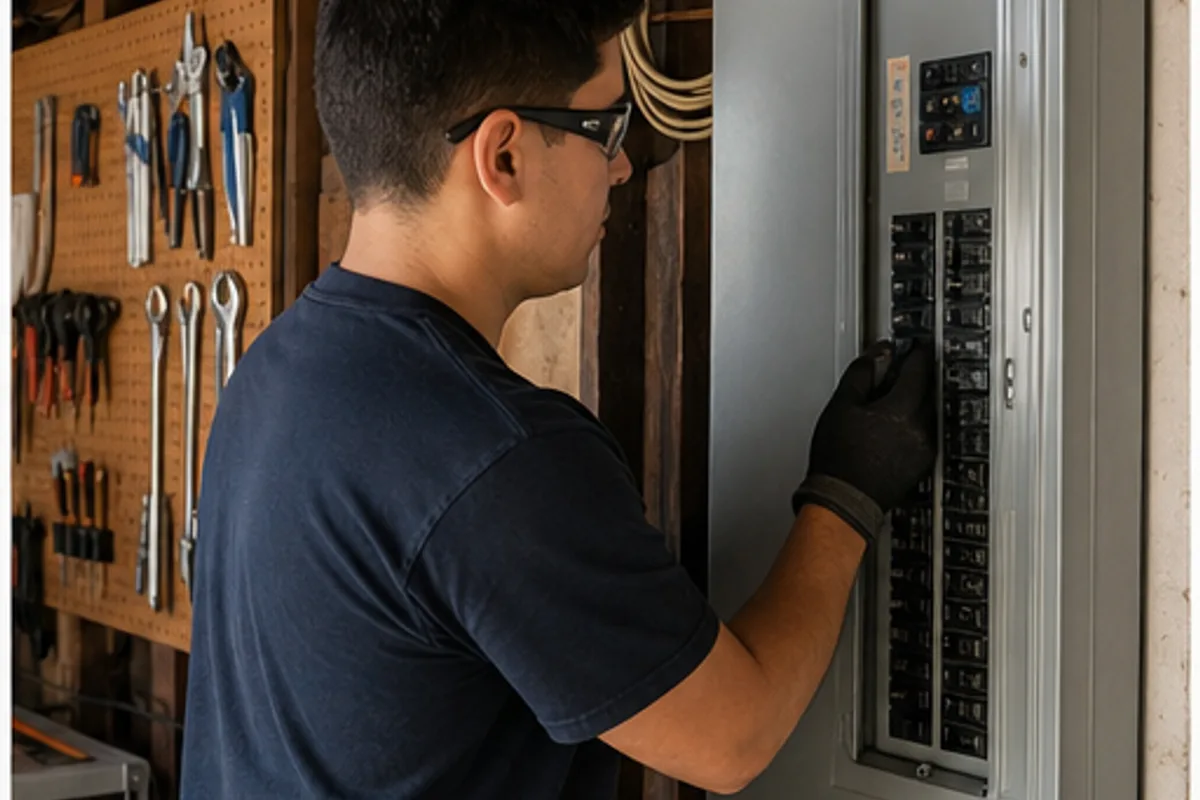
Power-system data points

  • panel brand, amperage, breaker space, and directory accuracy
  • meter location and utility-side access
  • grounding, bonding, GFCI, and AFCI clues
  • route distance to garage, exterior wall, appliance, or HVAC equipment
  • future loads such as heat pumps, HPWHs, EV charging, ADUs, and remodel circuits

Industry access notes

  • send one wide exterior photo and one close equipment photo so access is verified before pricing

Industry background that shapes the lighting installation scope

Era and stock: The City of Industry incorporated in 1957 specifically as an industrial enclave, with land use intentionally weighted toward manufacturing, logistics, and rail-served warehousing. The few residential pockets predate incorporation and survive as legal nonconforming use within an otherwise industrial zoning map.

Housing mix: Residential work is rare and mostly concentrated in small pre-1957 pockets of 1940s-1950s single-family homes on 5,000-7,500 sq ft lots tucked between industrial parcels. Most calls in Industry are commercial -- warehouse rooftop units, three-phase service work, and process plumbing.

Streets and landmarks: The 60 freeway corridor and the parallel rail lines define the industrial spine, with Valley Boulevard and Gale Avenue carrying most of the truck traffic. Residential pockets are isolated and small enough to identify by parcel rather than by neighborhood name.

What drives most retrofits here: Commercial work dominates -- rooftop package unit changeouts, three-phase panel upgrades, and grease interceptor and backflow service for tenant improvements. The few residential calls usually involve aging 1950s services and whole-home upgrades when a parcel changes hands.

Permit gotcha for Industry: City of Industry Public Works handles permits, and the workflow is built around commercial and industrial submittals. Residential permits are uncommon enough that plan check can take longer than a comparable LA County submittal, and Title 24 residential forms sometimes get scrutinized harder simply because the reviewers see fewer of them.

Local signal stack

SGV industrial corridor
City building authority
SCE, SoCalGas, and commercial-adjacent utility context
industrial-adjacent residential pockets and service-heavy properties
truck access, utility rooms, and mixed-use adjacency
commercial-adjacent electrical and plumbing conditions deserve precise scope boundaries
multi-era remodels in Eastside and SGV homes often hide old junctions above ceiling finishes
old switch loops, no neutrals, shallow boxes, plaster ceilings, and exterior weather protection can complicate lighting work

This stack is why the page is not a doorway page. A lighting installation visit in Industry has a different access, utility, permit, housing, and failure-mode profile than the same service in a coastal condo, Valley ranch home, or Westside estate canyon.

What can go wrong with lighting installation

The most expensive mistake is approving a narrow repair before the surrounding constraint is understood. A component can be replaced while airflow stays bad, a fixture can be installed while the shutoff is failing, a charger can be mounted before the panel is ready, or a drain can be cleared while a broken lateral remains undocumented.

For lighting installation in Industry, our first-pass checklist is switch wiring, fixture support, dimmer compatibility, wet-location needs, patching exposure. That list is short enough to use during booking and specific enough to prevent most blind quotes.

Permit, utility, and inspection context

The authority starting point for Industry is City building authority. Utility context is SCE, SoCalGas, and commercial-adjacent utility context. Depending on scope, the work may need a permit, plan review, utility service planning, rebate paperwork, HERS or energy-code documentation, or a final inspection. LADBS notes that work is not approved until inspected and accepted, and that covered or concealed work may need to remain visible.

That matters for homeowners because a cheaper visit can become expensive if drywall, stucco, trench, conduit, venting, or piping is closed before the right inspection stage.

lighting installation cost drivers in Industry

DriverWhy it matters locallyHomeowner action
Accesstruck access, utility rooms, and mixed-use adjacency can increase setup time, ladder needs, parking coordination, or equipment route difficulty.Send photos before booking and clear the path.
Existing system ageindustrial-adjacent residential pockets and service-heavy properties often means mixed-era equipment, pipes, ducts, and wiring.Send model labels and prior repair history.
Utility and permit pathSCE, SoCalGas, and commercial-adjacent utility context and City building authority influence sequence and documentation.Ask whether the work is repair, replacement, or upgrade.
Service-specific riskold switch loops, no neutrals, shallow boxes, plaster ceilings, and exterior weather protection can complicate lighting work.Approve diagnosis before approving a large replacement.

Planning range for lighting installation: $350 to $5 400. This is not a guaranteed price; it is a useful starting range before access, condition, permits, and related trade needs are confirmed.

Homeowner checklist before the visit

When to call now

Call or book immediately if there is active leaking, sewage backup, burning odor, sparking, wet electrical equipment, no cooling during heat, no heat with a safety concern, repeated breaker trips, a gas smell, visible smoke, or water spreading into finished rooms. If natural gas is suspected, leave the area and follow utility emergency instructions from a safe location.

When to plan instead of panic

If the system works but is old, inefficient, noisy, undersized, or incompatible with a planned EV charger, heat pump, ADU, repipe, or remodel, use a retrofit check. Planned sequencing usually costs less than emergency replacement because panel, pipe, duct, venting, and permit issues can be solved before demolition or equipment ordering.

Related electrical and multi-trade pages

Nearby city pages for lighting installation

Inspection-summary reviews from San Gabriel Valley Basin + East/Northeast LA River Corridor homes

Each review is also emitted in the page JSON-LD with a 1:1 match between visible and structured-data text. Author names use first name and last initial only, and ratings reflect the actual review (some 4-star reviews are included where homeowners flagged a real complaint that was resolved).

★★★★★ Hyun-Joo P. San Marino

Old 14 SEER unit was 19 years old and the evaporator was rusted through. Talia walked us through three AHRI directory match options before we settled on a Bosch IDS 2.0 paired with a variable-speed air handler. SEER2 18.5, AHRI matched rating documented on the invoice, and the Title 24 HERS sample passed first try. Bungalow Heaven district HOA letter was handled without us chasing it.

★★★★☆ Esteban J. Pico Rivera

200A Square D QO upgrade ahead of an EV install. Work was clean, LADWP coordination was tight, and the load calc memo was emailed to me as a PDF. Took a star off because the first inspection failed on a labeling issue, the breaker directory was not filled out, which feels like something the crew should have caught before calling for inspection. They came back same week and re-passed without drama.

★★★★★ Demarco F. Garvanza

Original 1924 craftsman had galvanized everywhere and a 0.6 GPM flow at the worst fixture. They built a manifold off a new 3/4-inch L copper drop, ran PEX-A home runs to 11 fixtures, and patched at 13 strategic points to minimize plaster damage. Static held at 60 PSI on the new PRV, flow at the worst fixture came up to 5.1 GPM. LADBS pre-cover signed off.

Questions homeowners ask before booking

Do I need a permit for lighting installation in Industry?

City of Industry Public Works handles permits, and the workflow is built around commercial and industrial submittals. Residential permits are uncommon enough that plan check can take longer than a comparable LA County submittal, and Title 24 residential forms sometimes get scrutinized harder simply because the reviewers see fewer of them. For lighting installation specifically, equipment replacement, new circuits, repiping, panel work, water-heater replacement, and concealed work commonly need permit or inspection planning. City building authority is the starting point.

What kind of homes are typical in Industry, and how does that change lighting installation?

Residential work is rare and mostly concentrated in small pre-1957 pockets of 1940s-1950s single-family homes on 5,000-7,500 sq ft lots tucked between industrial parcels. Most calls in Industry are commercial -- warehouse rooftop units, three-phase service work, and process plumbing. Commercial work dominates -- rooftop package unit changeouts, three-phase panel upgrades, and grease interceptor and backflow service for tenant improvements. The few residential calls usually involve aging 1950s services and whole-home upgrades when a parcel changes hands.

What should I send before booking lighting installation?

Send photos of the equipment, panel, shutoff, access path, symptom, model labels, and any previous repair notes. For Industry, include parking, alley, crawlspace, attic, garage, or HOA constraints because truck access, utility rooms, and mixed-use adjacency can change the dispatch plan.

What local landmarks help dispatch find access in Industry?

The 60 freeway corridor and the parallel rail lines define the industrial spine, with Valley Boulevard and Gale Avenue carrying most of the truck traffic. Residential pockets are isolated and small enough to identify by parcel rather than by neighborhood name. Note any cross-streets, gated communities, alley cleanouts, or hillside constraints in the booking note so the technician arrives ready for the actual route, not a curb-only assumption.

Can the same visit check related HVAC, electrical, or plumbing issues?

Yes. The site is built around air, power, and water coordination. A electrical visit can also note visible panel, pipe, drain, shutoff, duct, water-heater, or condensate issues that should be considered before a larger upgrade.

Map the lighting installation issue in Industry before the scope expands.

Send the symptom, equipment photos, panel photo, shutoff location, access constraints, and urgency. The booking path stays external so there is no fake form and no invented phone number.

Sources used for this guidance

LADBS Plan Check and PermitCity of Los Angeles electrical, mechanical, plumbing, and plan-check context.LADBS InspectionPermitted work is not approved until inspected and accepted; concealed work must remain visible for inspection.Los Angeles County Express PermitsSimple residential express permits can cover water-heater replacement, AC/heating replacement, drain repair, lighting, and panel replacement where plan review is not required.CEC 2025 Building Energy Efficiency Standards2025 Energy Code applies to permit applications on or after January 1, 2026 and expands heat-pump and electric-readiness requirements.CEC HVAC Energy Code SupportHVAC systems installed in California must comply with Building Energy Efficiency Standards.LADWP EV Charger RebateResidential Level 2 EV charger rebate and dedicated meter context.LADWP Charger InstallationLADWP recommends service assessment before EV charger installation and explains LADBS/LADWP inspection touchpoints.SCE Charge Ready HomeSCE panel-upgrade rebate context for qualifying Level 2 EV charger work.Pasadena Water and Power Electrify Your HomePWP electrification rebates for heat pumps, heat-pump water heaters, and panel work.SoCalGas Appliance Maintenance and SafetyGas furnace, water-heater, carbon-monoxide, earthquake strapping, and appliance clearance safety guidance.SoCalGas Emergency InformationEmergency natural-gas leak response guidance.ENERGY STAR HVAC Quality InstallationQuality installation topics such as correct refrigerant charge, airflow, ductwork, and equipment sizing.
Map My Repair Call