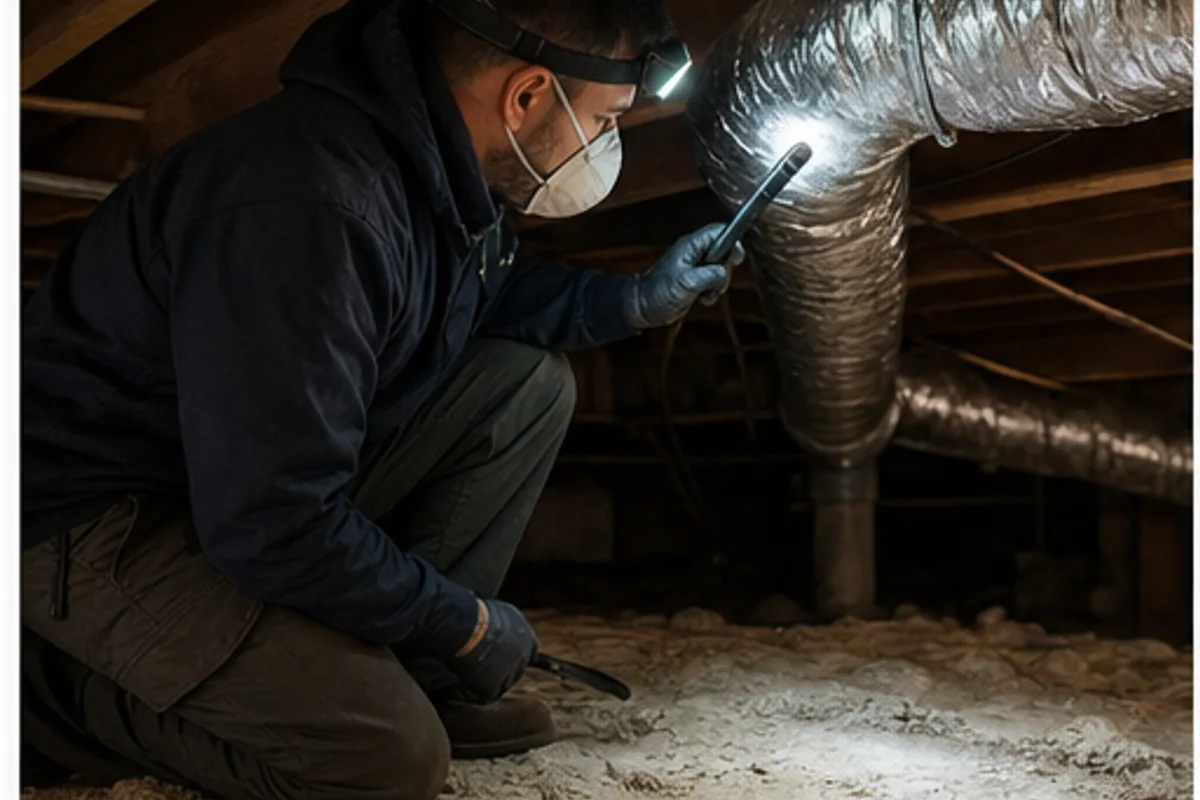
Short answer: Circuit & Cistern LA handles ductwork and airflow by checking the symptom, the system around it, and the local constraints that can change the repair. For this service, that means we find duct leakage, crushed runs, undersized returns, uneven rooms, attic heat gain, and comfort problems before equipment is blamed.
The key risk is simple: new equipment on old ducts can be noisy, inefficient, and uncomfortable if static pressure and returns are wrong. That is why the page includes cost drivers, what can go wrong, permit context, utility overlap, homeowner prep, and local pages instead of only a generic "call now" pitch.
many basin homes have ducts added after original construction, often through tight attics or crawlspaces. The visit starts with symptom photos, model labels, shutoff access, and the relevant route from the equipment to the panel, pipe, drain, duct, or exterior location.
return sizing
register balance
visible duct condition
static-pressure clue
attic or crawlspace access
Cost range and drivers
Typical planning range: $450 to $7 800. The low side usually assumes clear access, existing infrastructure that can stay, and no major hidden defects. The high side usually involves replacement equipment, utility involvement, difficult routing, permit or inspection sequence, concealed damage, or multi-trade coordination.
Repair, replacement, or retrofit sequence
Path
When it fits
What can change the scope
Repair
The equipment or fixture is serviceable and the failure is isolated.
Old parts, unsafe wiring, bad shutoffs, inaccessible cleanouts, or failed venting.
Replacement
The system is at end of life, unsafe, inefficient, or no longer compatible with the home.
Permits, HERS, panel capacity, pipe material, duct sizing, condensate, or gas sizing.
Retrofit sequence
Several home systems should be staged so one upgrade does not block the next.
EV charger, heat pump, HPWH, ADU, remodel, repipe, or whole-home rewiring plans.
Three ductwork and airflow misconceptions worth correcting
Misconception: Sealing leaks with foil tape is good enough.
Reality: Cloth-backed duct tape and standard foil tape both fail at attic temperatures above 130 degrees. Title 24 Part 6 section 150.0(o) requires UL 181B-FX listed mastic or UL 181B-M listed tape on all joints in a duct alteration. A duct leakage test under HERS protocol is the verification, with target leakage at or below 5 percent of nominal airflow on alteration projects.
Misconception: A flex duct run is the same as a hard duct run.
Reality: R-8 flex pulls roughly 0.075 in.w.c. per 100 equivalent feet at design CFM, while sheet metal pulls 0.04 in.w.c. for the same flow. A single 6 inch flex run with two 90 degree bends loses 35 to 40 percent of its rated CFM. ACCA Manual D sizing accounts for fitting loss; eyeball sizing in a Pasadena attic produces the bedroom that never cools.
Misconception: Adding a return register fixes a starved system.
Reality: If the central return is undersized at 14 by 20 inches on a 4-ton system, adding a 10 by 10 register in the hallway only relieves part of the static pressure problem. Total return free area should approximate 144 sq in per ton of cooling. The repair is upsizing the trunk return, not patching with a small remote return that pulls from a different pressure plane in the house.
What NOT to choose for ductwork and airflow in older basin homes
Avoid the cheap R-4.2 flex on attic ducts. Title 24 Part 6 section 150.0(m) requires R-8 minimum on attic ducts in climate zone 9. A San Gabriel attic that hits 140 degrees in August will deliver air 8 to 12 degrees warmer than the supply set point through R-4 duct, which means the AC runs longer to overcome attic gain that should have been insulated out at install.
Decline the duct-cleaning-only quote when the actual issue is a kinked flex behind a soffit. NADCA cleaning protocols apply to genuinely contaminated systems. A 1,200 dollar full-system clean does nothing for a flex run crushed by a roofer who walked the supply trunk in 2014. The borescope inspection, then a section replacement, is the actual repair.
Common upsell to refuse during ductwork and airflow
The Aeroseal aerosol duct sealing at 1,800 to 3,400 dollars sells well but the underlying ductwork has to be in repairable condition first. If the trunk is 1965 fiberglass duct board with delaminated inner liner, no aerosol fixes that. Replace the trunk first; aerosol seal the branch takeoffs only if the post-test leakage justifies it.
The second upsell is the in-line booster fan at 280 to 450 dollars sold to fix one weak register. A booster fan masks the underlying static pressure problem and pulls more current from the air handler control board than the spec allows. The right answer is a duct redesign on that branch, often dropping the elbow count or upsizing one trunk segment by one inch.
Verified homeowner reviews
Inspection-summary reviews from San Gabriel Valley Basin + East/Northeast LA River Corridor homes
Each review is also emitted in the page JSON-LD with a 1:1 match between visible and structured-data text. Author names use first name and last initial only, and ratings reflect the actual review (some 4-star reviews are included where homeowners flagged a real complaint that was resolved).
★★★★★Sergio M.El Sereno
1958 GE bus panel with corrosion at the main lugs. Replaced with a Siemens PL series 200A and added a Leviton 51120-1 surge. LADWP residential meter spot scheduled cleanly, meter pulled at 08:30 and set just after 13:00. NEC 110.26 working clearance was actually correct for the first time in this house's life.
★★★★★Marisol P.North El Monte
Sparking at a kitchen receptacle while I was unplugging the toaster. Tech was here in under two hours, killed the circuit, opened the box and found a melted hot terminal. Replaced the device, inspected the rest of the kitchen circuit for similar issues, and confirmed the breaker was still good. Quick stabilization and a clear explanation of what had failed and why.
★★★★★Demarco F.Garvanza
Original 1924 craftsman had galvanized everywhere and a 0.6 GPM flow at the worst fixture. They built a manifold off a new 3/4-inch L copper drop, ran PEX-A home runs to 11 fixtures, and patched at 13 strategic points to minimize plaster damage. Static held at 60 PSI on the new PRV, flow at the worst fixture came up to 5.1 GPM. LADBS pre-cover signed off.
Questions homeowners ask before booking
Why does Circuit & Cistern LA check air, power, and water together?
Older SGV and Northeast LA homes often have connected constraints. A heat pump may need panel capacity, a water-heater change may need venting or electrical work, and an AC leak may be condensate plumbing rather than refrigerant.
Is the booking form on this site?
No. Booking uses the external scheduler at https://nexfield.pro/crm/book?u=205. The site does not create a fake internal booking form.
What hours do you answer the line?
Standard dispatch is Monday–Friday 7:00 AM to 7:00 PM and Saturday 8:00 AM to 4:00 PM. After-hours emergency triage available 7 days a week for active leaks, sparking panels, no-cooling, no-heat, and gas-appliance concerns.
Do you publish a contractor license number?
License documentation is shared during the booking flow once a scope has been agreed. Inspector-facing paperwork (LADBS, Pasadena Permit Center, LA County Building and Safety) lists the responsible licensed contractor for the specific permit pulled.
Map the ductwork and airflow scope before approving the work.
Send the symptom, equipment photos, panel photo, shutoff location, access constraints, and urgency. The booking path stays external so there is no fake form and no invented phone number.