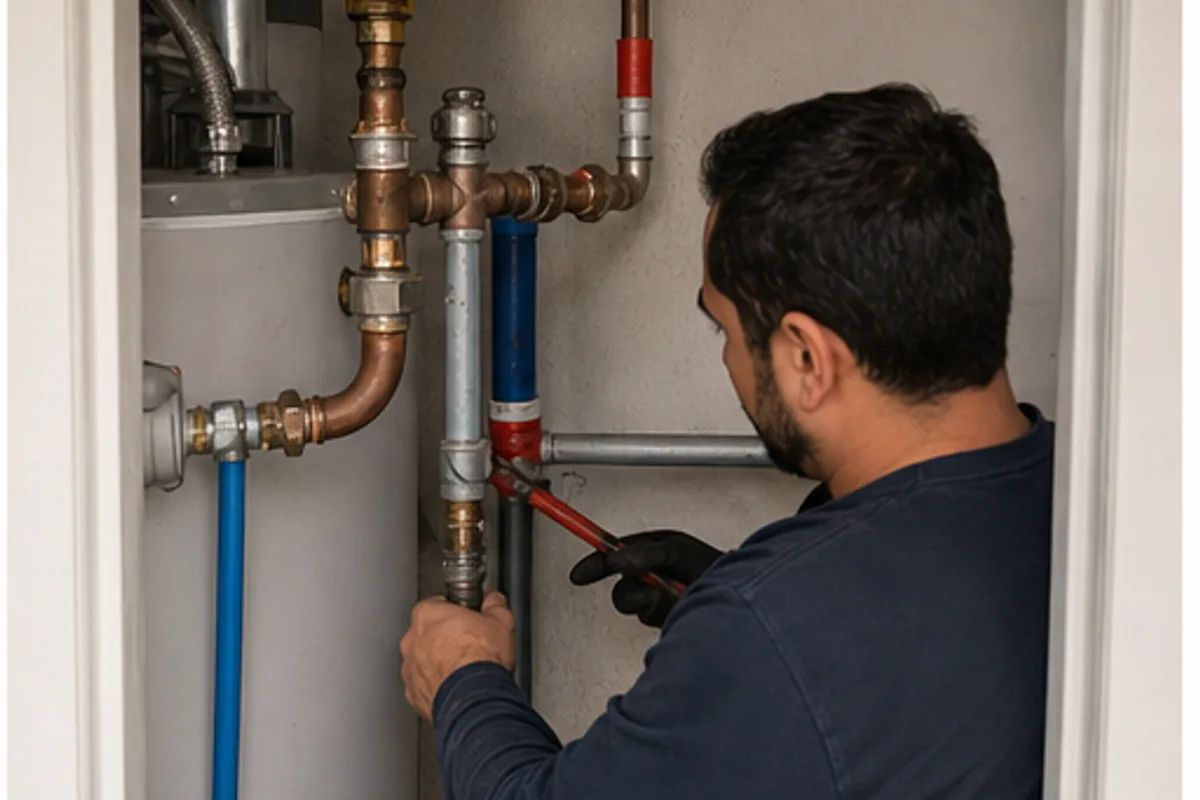
Short answer: Circuit & Cistern LA handles repiping by checking the symptom, the system around it, and the local constraints that can change the repair. For this service, that means we replace aging supply piping with coordinated access, fixture shutoffs, patch planning, water-heater tie-ins, and inspection-ready work.
The key risk is simple: repiping can expose undersized service, old valves, fixture corrosion, water-pressure issues, and permit or patch sequencing. That is why the page includes cost drivers, what can go wrong, permit context, utility overlap, homeowner prep, and local pages instead of only a generic "call now" pitch.
many SGV homes have mixed galvanized, copper, and PEX transitions that need a whole-system plan. The visit starts with symptom photos, model labels, shutoff access, and the relevant route from the equipment to the panel, pipe, drain, duct, or exterior location.
pipe material
pressure symptoms
fixture count
access points
water heater tie-in
Cost range and drivers
Typical planning range: $7 800 to $36 000. The low side usually assumes clear access, existing infrastructure that can stay, and no major hidden defects. The high side usually involves replacement equipment, utility involvement, difficult routing, permit or inspection sequence, concealed damage, or multi-trade coordination.
Repair, replacement, or retrofit sequence
Path
When it fits
What can change the scope
Repair
The equipment or fixture is serviceable and the failure is isolated.
Old parts, unsafe wiring, bad shutoffs, inaccessible cleanouts, or failed venting.
Replacement
The system is at end of life, unsafe, inefficient, or no longer compatible with the home.
Permits, HERS, panel capacity, pipe material, duct sizing, condensate, or gas sizing.
Retrofit sequence
Several home systems should be staged so one upgrade does not block the next.
EV charger, heat pump, HPWH, ADU, remodel, repipe, or whole-home rewiring plans.
Reality: Modern PEX-A (Uponor AquaPEX) or PEX-B (Viega PureFlow) repipe in a 1,400 sq ft single-story bungalow opens 22 to 36 small access points: behind each fixture, at each riser, and at strategic top-plate transitions. The plaster patch, prime, and paint scope is real (1,400 to 2,800 dollars) but it is not full demo.
Misconception: PEX is the same regardless of brand or method.
Reality: PEX-A (Uponor) uses an expansion tool and shape-memory ring; PEX-B (Viega PureFlow) uses crimp or press connections. The two systems are not field-interchangeable: an Uponor expansion fitting on PEX-B leaks; a Viega crimp on PEX-A misperforms. The repipe scope locks the system at design, and the homeowner should know which system is in the walls.
Misconception: Copper is the gold standard.
Reality: Type L copper is durable but susceptible to pinhole corrosion in basin water chemistry, and the 2025 copper price runs material 60 to 90 percent above PEX-A for the same scope. PEX-A passes the same CPC section 605 listing requirements, has a longer fatigue life under freeze-thaw (less of a basin issue) and chemistry exposure, and is the documented majority choice in 2025 California residential repipe.
What NOT to choose for repiping in older basin homes
Avoid CPVC under hot-line use in basin attic temperatures. CPVC is rated to 180 degrees but field failures track with thermal cycling above 140 degrees ambient combined with hot-water service, and a Pasadena attic in August clears 140 degrees regularly. PEX-A or copper handle the cycle; CPVC has a documented brittleness mode that drives a class of warranty replacements.
Decline the unpermitted partial repipe that leaves the original 1955 galvanized cold lines and replaces only the hot side. Galvanized cold lines continue to scale, drop pressure, and stain fixtures; the hot-only repipe addresses one symptom and ignores the underlying. Either commit to a full repipe or accept that the cold side will need a second project.
Common upsell to refuse during repiping
The whole-home filtration system bundle at 2,800 to 4,800 dollars during the repipe is the standard upsell. Filtration is a real category but it is a separate scope with its own bypass valving, drain, and maintenance cycle. Bundling the decision at the repipe visit forces a vendor lock-in; evaluate filtration separately based on the home's actual water quality test (chloramine, hardness, pH).
The second upsell is the recirculation loop in every bathroom on a single-story home where the longest hot-water run is 38 feet. A recirculation loop saves seconds and adds 80 to 220 dollars per year in standby loss. Reserve recirculation for two-story homes with longer runs, or for accessibility cases where the elderly homeowner has a documented need.
Verified homeowner reviews
Inspection-summary reviews from San Gabriel Valley Basin + East/Northeast LA River Corridor homes
Each review is also emitted in the page JSON-LD with a 1:1 match between visible and structured-data text. Author names use first name and last initial only, and ratings reflect the actual review (some 4-star reviews are included where homeowners flagged a real complaint that was resolved).
★★★★☆Amir K.San Marino
Rinnai RUR199iN install in a 1958 ranch off Huntington. Gas resize to 3/4 inch from the meter, dedicated 120V outlet, concentric vent. Quote said 2 days, ended up 4 days because plan check kicked it back twice for the condensate neutralizer detail. Talia kept us in the loop with photos at every plan-check trip and did not bill the extra time. Final hot water delivery is 0.4 gpm at 122 degrees on a cold morning.
★★★★★Aram T.Glassell Park
Glassell Park hillside house with a tight side yard. They sized a low-profile 3-ton heat pump, coordinated CEC §110.2 equipment listing requirements, and pulled a permit through LADBS. Title 24 HERS sample passed. Crew built a custom platform so the unit sits level on the slope and the line set is tucked along the foundation. Quiet at the property line, neighbor commented.
★★★★★Janelle T.Atwater Village
Wet spot in the ceiling drywall under the upstairs bath. They isolated the trap arm vs supply with a pressure test and pinpointed it to a hairline crack in the shower pan, not a pipe. Saved me from tearing into the tile. Wrote up the scope for the tile guy and we picked up the leak detection portion only. Honest call.
Questions homeowners ask before booking
Why does Circuit & Cistern LA check air, power, and water together?
Older SGV and Northeast LA homes often have connected constraints. A heat pump may need panel capacity, a water-heater change may need venting or electrical work, and an AC leak may be condensate plumbing rather than refrigerant.
Is the booking form on this site?
No. Booking uses the external scheduler at https://nexfield.pro/crm/book?u=205. The site does not create a fake internal booking form.
What hours do you answer the line?
Standard dispatch is Monday–Friday 7:00 AM to 7:00 PM and Saturday 8:00 AM to 4:00 PM. After-hours emergency triage available 7 days a week for active leaks, sparking panels, no-cooling, no-heat, and gas-appliance concerns.
Do you publish a contractor license number?
License documentation is shared during the booking flow once a scope has been agreed. Inspector-facing paperwork (LADBS, Pasadena Permit Center, LA County Building and Safety) lists the responsible licensed contractor for the specific permit pulled.
Map the repiping scope before approving the work.
Send the symptom, equipment photos, panel photo, shutoff location, access constraints, and urgency. The booking path stays external so there is no fake form and no invented phone number.