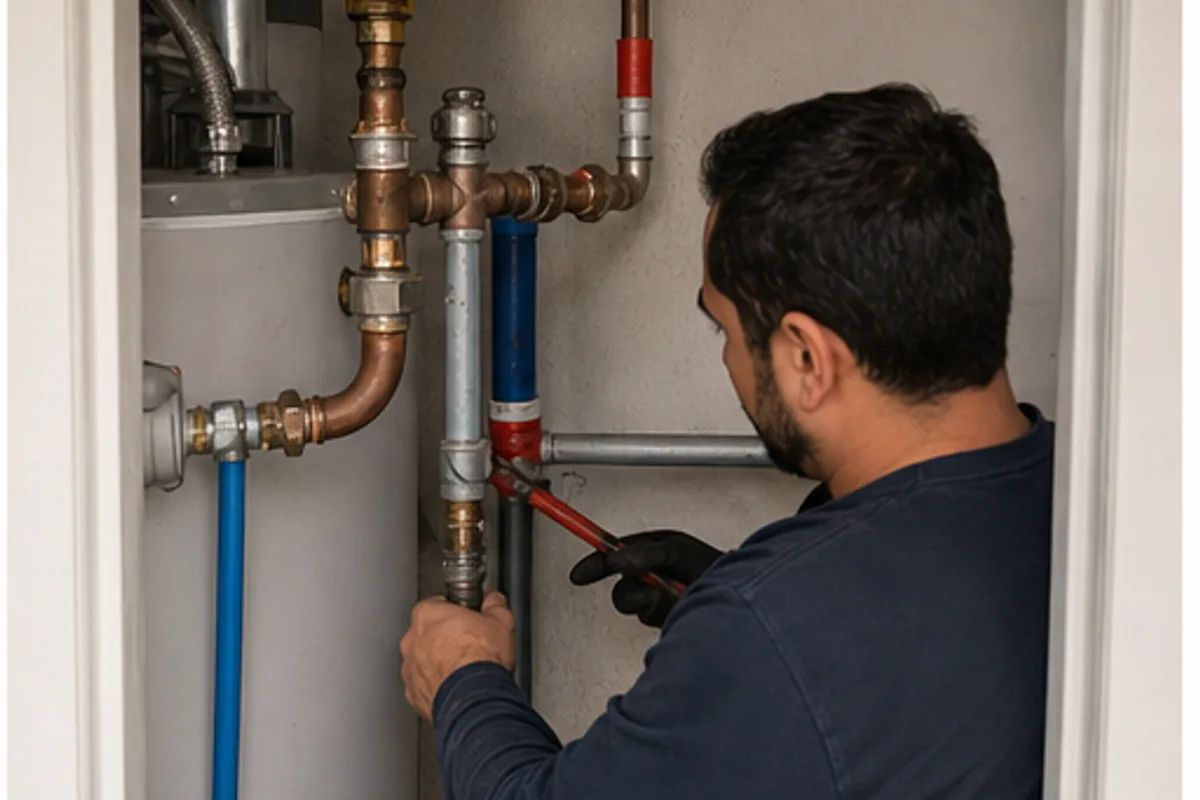
Short answer: Circuit & Cistern LA handles leak detection by checking the symptom, the system around it, and the local constraints that can change the repair. For this service, that means we find hidden supply, slab, wall, ceiling, fixture, irrigation, and water-heater leaks with non-destructive diagnostics where possible.
The key risk is simple: a small stain can come from pressurized supply, drain waste, condensate, roof intrusion, or appliance failure. That is why the page includes cost drivers, what can go wrong, permit context, utility overlap, homeowner prep, and local pages instead of only a generic "call now" pitch.
older copper-to-galvanized transitions and crawlspaces can hide leaks until a floor or wall shows damage. The visit starts with symptom photos, model labels, shutoff access, and the relevant route from the equipment to the panel, pipe, drain, duct, or exterior location.
meter movement
shutoff test
stain location
fixture history
water heater and pan
Cost range and drivers
Typical planning range: $250 to $1 800. The low side usually assumes clear access, existing infrastructure that can stay, and no major hidden defects. The high side usually involves replacement equipment, utility involvement, difficult routing, permit or inspection sequence, concealed damage, or multi-trade coordination.
Repair, replacement, or retrofit sequence
Path
When it fits
What can change the scope
Repair
The equipment or fixture is serviceable and the failure is isolated.
Old parts, unsafe wiring, bad shutoffs, inaccessible cleanouts, or failed venting.
Replacement
The system is at end of life, unsafe, inefficient, or no longer compatible with the home.
Permits, HERS, panel capacity, pipe material, duct sizing, condensate, or gas sizing.
Retrofit sequence
Several home systems should be staged so one upgrade does not block the next.
EV charger, heat pump, HPWH, ADU, remodel, repipe, or whole-home rewiring plans.
Three leak detection misconceptions worth correcting
Misconception: A high water bill always means a slab leak.
Reality: The first diagnostic is a static meter test: shut all fixtures, read the dial, wait 30 minutes, read again. Movement on the leak indicator (small triangle on the meter) confirms a leak somewhere; it does not localize it. A slab leak is one possibility; a running toilet flapper, an irrigation valve, a hot-water recirculation pump cycling, or a hose bib drip are more common.
Misconception: Acoustic detection finds every slab leak.
Reality: Acoustic ground-microphone detection works on pressurized lines making detectable noise. A pinhole in a 1/2 inch copper hot line at 60 psi makes a detectable signature; a slow weep in a cold line at low pressure may not. Tracer-gas (helium or hydrogen-nitrogen mix) and thermal imaging fill the gap when acoustic alone underperforms.
Misconception: Pinhole leaks in copper are random.
Reality: Pinholes follow a pattern: hot lines fail before cold, lines under slabs fail before lines in walls, and water chemistry from PWP, LADWP, and SCV districts vary in chloramine and pH that drives pitting corrosion. A first pinhole at year 35 in a 1962 SoCal copper system suggests a system-wide pattern, not a random event. The remediation conversation is repipe, not patch-by-patch.
What NOT to choose for leak detection in older basin homes
Avoid the no-locate jackhammer-the-suspect-area approach. Tearing 18 sq ft of slab to chase an acoustic guess that was off by 3 feet costs 1,800 to 3,200 dollars in finish repair on top of the leak repair. Spend the 380 to 580 dollars on a documented locate (acoustic plus tracer gas plus thermal) before the slab opens.
Decline the leak detection that does not include a written report with photos and footage measurements from a fixed reference point (front entry threshold, garage stem wall corner). The report is the basis for the repair scope and the homeowner's insurance claim if the leak qualifies. A verbal locate without documentation is half the deliverable.
Common upsell to refuse during leak detection
The full repipe quote handed over at the leak detection visit is the standard upsell. A single pinhole in a 30-year-old copper system might warrant repipe consideration, but it does not require repipe at the same visit as the detection. Repair the leak, gather the data on whether more leaks appear in the next 18 months, then decide on repipe with evidence.
The second upsell is the smart leak detection sensor package (Watts FloodSafe, Phyn) at 1,200 to 2,400 dollars on top of the actual leak repair. Smart sensors are valuable products, especially on second-floor laundry and water heater pans, but they are a separate decision. Fix the active leak, then evaluate sensors against the home's actual risk pattern.
Verified homeowner reviews
Inspection-summary reviews from San Gabriel Valley Basin + East/Northeast LA River Corridor homes
Each review is also emitted in the page JSON-LD with a 1:1 match between visible and structured-data text. Author names use first name and last initial only, and ratings reflect the actual review (some 4-star reviews are included where homeowners flagged a real complaint that was resolved).
★★★★☆Henrietta D.Atwater Village
Slab leak on Christmas week, took out a 20A circuit when the moisture hit a junction box. They were on site within 3 hours, dried the box, isolated the circuit, and re-routed the hot line through the attic with PEX-A. Star off because the final invoice was harder to read than it needed to be, the labor was bundled across trades. They sent a redone invoice with line items the next day.
★★★★☆Phuong D.West Covina
Interlock kit on the existing main panel plus a generator inlet box on the side yard, wired with 10/3 to a 30A inlet. The work is solid and inspection passed clean. Only complaint is the original quote line for the inlet box was a little vague and the final invoice had an extra labor item I had to ask about. They explained it and it was reasonable, just wish it had been clearer up front.
★★★★★Devika P.Arcadia
Two-stage furnace plus AC was wired as single-stage by the previous installer. Tech swapped in an Ecobee Premium, re-pulled the C-wire properly, and configured staging so the second stage only kicks above a measurable delta. Verified delta T of 18 degrees on cooling after the change. Chapman Woods house cycles less and the upstairs is no longer two degrees behind.
Questions homeowners ask before booking
Why does Circuit & Cistern LA check air, power, and water together?
Older SGV and Northeast LA homes often have connected constraints. A heat pump may need panel capacity, a water-heater change may need venting or electrical work, and an AC leak may be condensate plumbing rather than refrigerant.
Is the booking form on this site?
No. Booking uses the external scheduler at https://nexfield.pro/crm/book?u=205. The site does not create a fake internal booking form.
What hours do you answer the line?
Standard dispatch is Monday–Friday 7:00 AM to 7:00 PM and Saturday 8:00 AM to 4:00 PM. After-hours emergency triage available 7 days a week for active leaks, sparking panels, no-cooling, no-heat, and gas-appliance concerns.
Do you publish a contractor license number?
License documentation is shared during the booking flow once a scope has been agreed. Inspector-facing paperwork (LADBS, Pasadena Permit Center, LA County Building and Safety) lists the responsible licensed contractor for the specific permit pulled.
Map the leak detection scope before approving the work.
Send the symptom, equipment photos, panel photo, shutoff location, access constraints, and urgency. The booking path stays external so there is no fake form and no invented phone number.